Introduction: The New Frontier of Fun
Forget everything you remember about the clunky headsets and motion sickness of the early 2020s. In 2026, the virtual reality theme park has undergone a radical transformation. We have moved from simple digital simulations to “Hyper-Reality”—environments where the line between the physical and the digital has practically vanished.
Whether you are a thrill-seeker looking for the world’s most advanced roller coaster or a business owner looking to tap into the immersive entertainment market, this guide explores how the latest technology is redefining the way we play, socialize, and explore.
Why VR Theme Parks are the Future of Entertainment
In 2026, the local virtual reality theme park has officially moved from a “geeky novelty” to a mainstream weekend staple. As traditional amusement parks struggle with aging mechanical infrastructure and massive land requirements, immersive entertainment venues are scaling at a record pace.
Here is why the high-tech shift is more than just a trend—it’s a total reimagining of the future of theme parks.
Beyond 4D: From Spectator to Protagonist
For decades, “immersion” in a park meant a vibrating seat and a splash of water during a 3D movie. We’ve moved far beyond that. The current generation of VR attractions uses agency-driven narratives where your physical actions determine the outcome of the story.
- High Refresh Rates: Thanks to the 240Hz standards of 2026, the “motion sickness” that plagued early 2020s tech is virtually extinct.
- Tactile Reality: Modern parks blend physical props with digital overlays. If you pick up a torch in a virtual dungeon, you are holding a weighted, haptic-enabled controller in the real world that mimics the heat and flicker of the flame.
Social Connectivity: The New “Third Place”
The image of a solitary gamer in a dark room is dead. Today’s multiplayer VR arenas are social hubs.
- Shared Presence: Whether you’re using “Zero Latency” free-roaming tech or a “Sandbox VR” style pod, you see your friends as high-fidelity, full-body avatars.
- Family-Centric Play: Parks are now designing “co-op” experiences where parents and children must solve puzzles together, making virtual reality theme parks the ultimate venue for modern family bonding.
Space Efficiency: The “Infinite World” in a 40-Meter Box
One of the most disruptive aspects of this industry is the footprint. A traditional roller coaster requires acres of land and millions in steel. A top-tier high-tech amusement center can offer a dozen different “worlds” within a 40-square-meter floor plan.
- Digital Updates: Unlike physical rides that take years to renovate, a VR attraction can be “re-themed” overnight with a software update.
- Urban Accessibility: This efficiency allows these parks to thrive in the middle of downtown shopping districts and malls, bringing the “big park” thrill to your doorstep.
Top-Rated VR Attractions You Can’t Miss in 2026
The landscape of VR theme park attractions has shifted from simple stationary pods to massive, multi-sensory environments. If you are looking for the absolute best VR rides this year, these are the three categories currently dominating the global leaderboard.
Hyper-Realistic Free-Roam Arenas
Free-roam is the gold standard for immersion. Unlike home setups tethered to a PC, these arenas allow you to physically walk through a warehouse-sized space that is digitally mapped to a fantasy world.
- The “Zero Latency” Evolution: In 2026, leading franchises like Zero Latency and Sandbox VR have introduced “4K-per-eye” wireless streaming, meaning you can sprint, take cover, and interact with teammates without a single cable in sight.
- Tactile Feedback: These arenas now utilize physical walls and props that align perfectly with the virtual world. If you see a railing in the game, you can lean on it in real life.
Hybrid Roller Coasters and Dark Rides
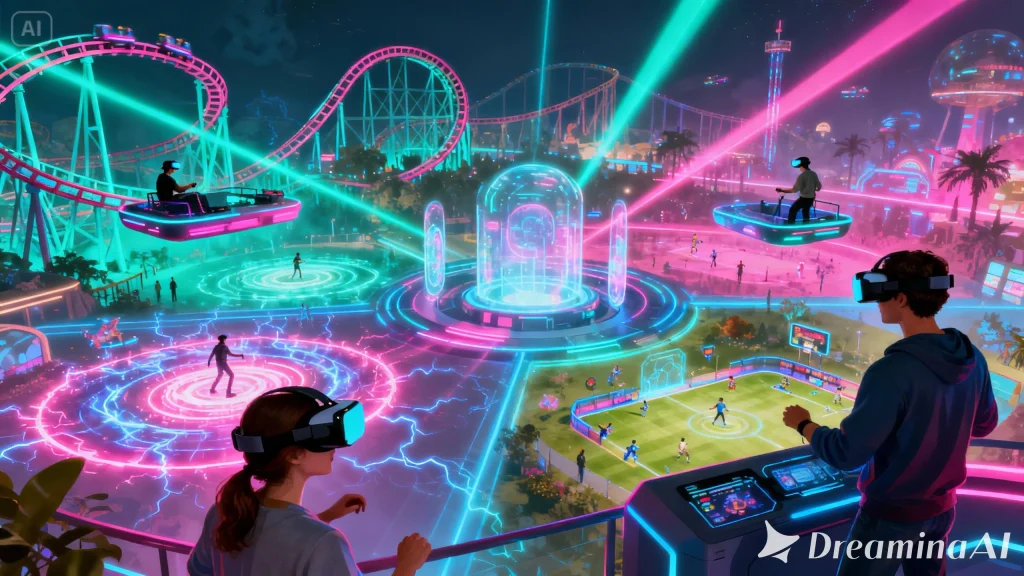
While pure VR parks are growing, traditional giants like Universal and Six Flags are mastering the hybrid VR coaster. These rides combine the physical G-forces of a real track with the limitless visuals of a headset.
- The 2026 Indoor Revolution: Look for the new Legoland indoor coasters debuting this year, which use “augmented-VR” overlays to blend physical LEGO sets with digital animations.
- Enhanced Simulation: Popular dark rides, such as the latest iterations of the Harry Potter and the Escape from Gringotts style, now use “active-shutter” VR glasses that allow riders to see both the physical high-definition sets and 3D digital characters simultaneously.
AI-Driven NPCs and Interactive Storytelling
The most significant trend in 2026 is the “Living Story.” Thanks to generative AI, the characters you meet in a virtual reality theme park are no longer following a script.
- Natural Language Interaction: In attractions like “The AI Archive” or the latest Star Wars-themed VR adventures, you can speak directly to NPCs. They use real-time AI to listen, respond, and even change the ride’s ending based on how you treated them.
- Adaptive Difficulty: These rides use biometric sensors to measure your heart rate and eye movement, automatically adjusting the intensity or “scare factor” to match your personal comfort level.
The Technology Behind the Magic: AI, Haptics, and High-Speed Connectivity
If you visited a virtual reality theme park five years ago, you likely remember heavy backpacks and the occasional “screen-door effect.” In contrast, the technology of 2026 feels like a different world entirely. Because of the “holy trinity” of tech—Generative AI, advanced haptics, and ultra-low-latency 6G networks—the experience is now seamless.
Photorealistic Visuals: The 8K Standard
The immersion starts with what you see. Specifically, pixels have become invisible to the human eye. Modern headsets in premium parks now offer 8K VR resolution per eye. To handle this massive data load, parks use eye-tracking technology to perform dynamic foveated rendering. Consequently, the system only renders the exact spot you are looking at in full detail, which saves processing power while keeping your experience crystal clear.
AI-Driven NPCs: Characters That Remember You
The days of scripted robots are over. Instead, by using large language models (LLMs) and real-time voice processing, AI-driven NPCs (Non-Player Characters) now act as digital actors.
- Furthermore, these characters can hold natural conversations and detect the emotion in your voice.
- Most importantly, they recall your actions from earlier in the session to change the narrative on the fly.
Advanced Haptics: Feeling the Virtual World
True immersion requires more than just sight and sound. For this reason, when you enter a high-end arena, you will likely don a haptic feedback suit.
- First, sensory vests use micro-actuators to simulate physical sensations like wind or rain.
- Second, thermal haptics allow you to feel the heat of a dragon’s breath or the chill of an arctic cavern.
- As a result, your brain fully accepts the digital environment as physical reality.
Zero-Latency Connectivity
The biggest killer of immersion used to be “lag.” However, modern virtual reality theme parks utilize local edge computing to ensure zero-latency VR. This means the delay between your physical movement and the digital response is under 10 milliseconds. Therefore, the motion sickness issues of the past have been effectively eliminated.
Planning Your Visit: What to Expect
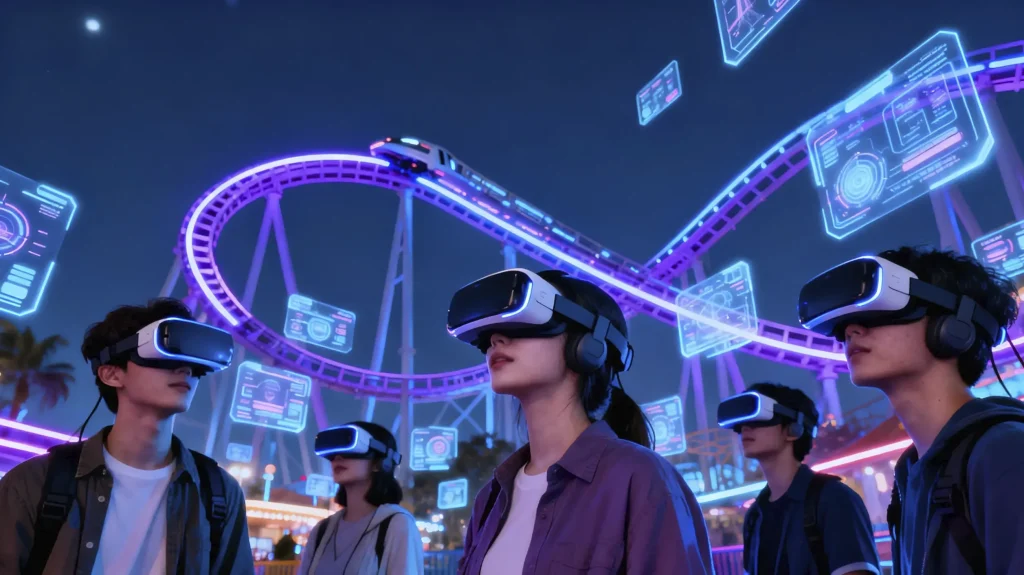
Stepping into a virtual reality theme park in 2026 is a seamless experience, but it requires a bit more digital preparation than a traditional park visit. From dynamic VR theme park prices to high-tech hygiene standards, here is how to ensure your first adventure is a “glitch-free” success.
The New Booking Standard: Reservations and Virtual Queues
Gone are the days of standing in two-hour lines. Most modern parks have transitioned to a reservation-only model to manage the data-heavy throughput of their systems.
- Dynamic Pricing: Much like airlines, VR theme park prices in 2026 often fluctuate based on demand. Booking mid-week or during “off-peak” digital hours can save you up to 30%.
- The Companion App: Before you arrive, you’ll likely need to download the park’s official app. This handles your QR-code entry, lets you pre-design your avatar, and manages your “Virtual Queue” (VQ) spots.
Health, Safety, and “Digital Hygiene”
Since you are sharing hardware with thousands of other guests, 2026 parks have turned sanitation into a high-tech science.
- UV-C Sanitization: After every use, headsets and haptic vests are placed into medical-grade UV-C sterilization chambers that kill 99.9% of bacteria and viruses in seconds.
- Disposable VR Masks: You will be provided with a moisture-wicking, disposable “ninja mask” to wear under the headset, ensuring a clean barrier between your skin and the device.
- Physical Safety Boundaries: Each arena uses “Guardian” or “Chaperone” systems—digital grids that appear in your vision if you get too close to a real-world wall.
Age and Height Requirements for Families
While VR is becoming more accessible, physical safety still dictates the rules.
- Age Limits: Most free-roam experiences require players to be at least 7 to 10 years old to ensure the headset fits securely and the content is age-appropriate.
- Height Restrictions: For hybrid coasters or motion-platform seats, a minimum height of 120cm (approx. 47 inches) is standard to ensure the safety restraints and haptic sensors align correctly with your body.
Conclusion: Reality is Just the Beginning
The virtual reality theme park of 2026 is no longer a glimpse into the future—it is the present standard for global entertainment. We have moved past the era of mere “gadgets” and entered a period of true digital craftsmanship. As we’ve explored, the fusion of AI-driven storytelling, high-fidelity haptics, and photorealistic 8K visuals has created a medium where the only limit is the designer’s imagination.
For the modern traveler, these parks offer an escape that is safer, more social, and more spectacular than ever before. For the industry, they represent a sustainable, space-efficient, and infinitely updatable frontier that is redefining what it means to “go to the movies” or “ride a coaster.” In this new era, reality isn’t being replaced; it’s being augmented by the most creative minds in tech.
Design Your World with Cebirra
Are you ready to transform a physical space into a limitless digital universe? At Cebirra, we don’t just build software; we architect memories. As a leading immersive technology company, our team specializes in end-to-end VR theme park design, from initial concept and AI character development to the deployment of complex projection mapping and haptic integration.
Whether you are looking to create a boutique urban “micro-park” or a massive multi-sensory arena, Cebirra provides the technical expertise and creative vision to bring your digital dream to life.
Ready to lead the entertainment revolution? Contact Cebirra Today to schedule a consultation with our lead designers and see how we can build your next immersive entertainment landmark.