Introduction
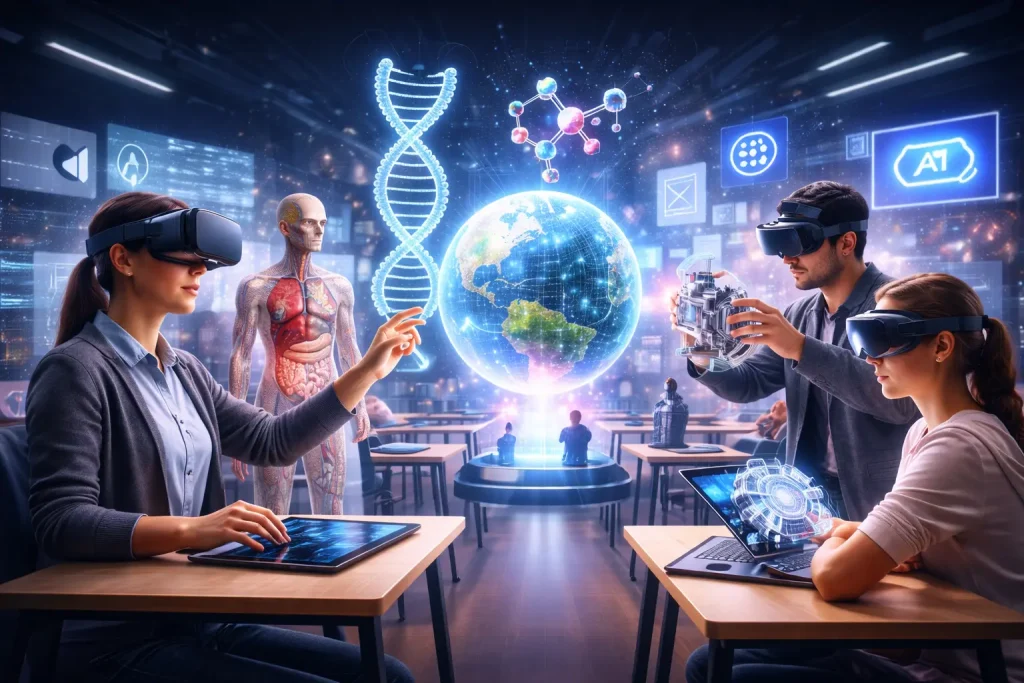
Immersive technology in education is transforming how students learn, interact, and develop real-world skills. By leveraging technologies such as Virtual Reality (VR), Augmented Reality (AR), and Mixed Reality (MR), educational institutions can create engaging, interactive, and highly effective learning experiences. This report explores the definition, benefits, applications, challenges, and future potential of immersive technology in education, providing a comprehensive and SEO-optimized overview aligned with Yoast SEO best practices.
Understanding Immersive Technology in Education
What Is Immersive Technology in Education?
Immersive technology in education refers to digital tools and environments designed to deliver multi-sensory, interactive learning experiences. These technologies allow learners to engage with content in ways that go beyond traditional classroom methods.
Extended Reality (XR) as an Umbrella Term
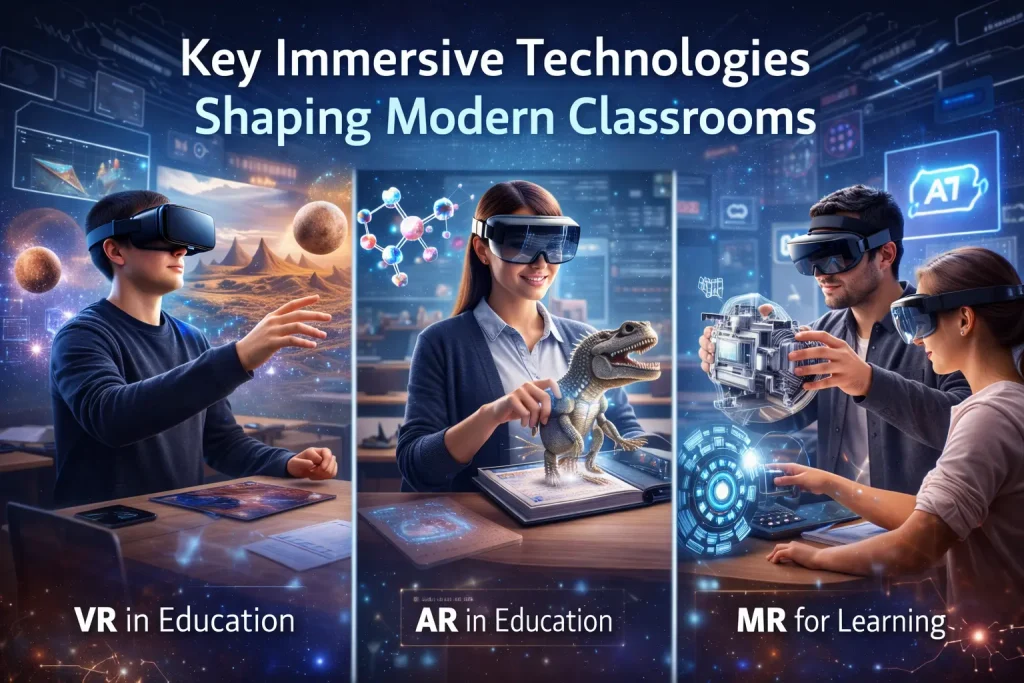
Immersive learning technologies are commonly grouped under Extended Reality (XR), which includes:
- Virtual Reality (VR) education, where learners enter fully digital environments.
- Augmented Reality (AR) education, which overlays digital elements onto the real world.
- Mixed Reality (MR) education, combining physical and virtual objects that interact in real time.
Through XR, immersive learning experiences can overcome physical, geographical, and conceptual limitations in education.
Transformative Benefits of Immersive Technology in Education
Enhanced Student Engagement and Learning Outcomes
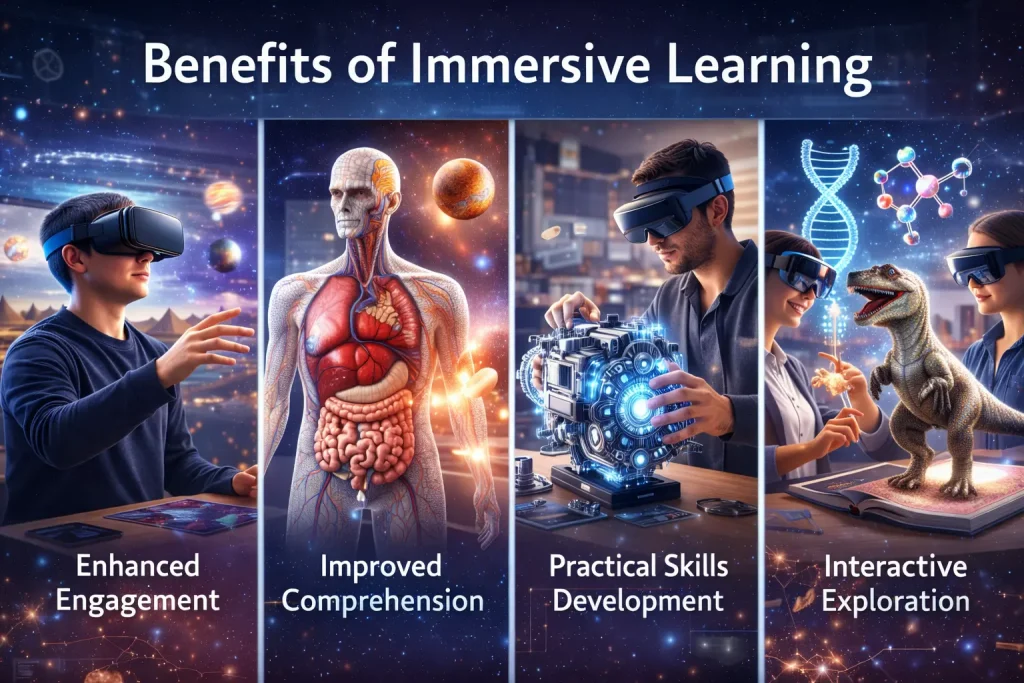
One of the main advantages of immersive technology in education is increased student engagement. XR-based learning encourages active participation rather than passive consumption.
- XR for student engagement improves focus and knowledge retention.
- VR’s impact on learning outcomes is evident in safe simulations that allow experimentation without real-world risks.
- AR for interactive learning helps visualize abstract concepts, making learning more intuitive and memorable.
As a result, immersive learning is more enjoyable and prepares students for complex, real-world challenges.
Practical Applications and Real-World Skills Development
Immersive technology in education is especially effective for hands-on and skills-based learning.
- VR for science education enables virtual labs, experiments, and dissections without safety concerns.
- VR for history lessons allows students to explore historical events and ancient civilizations in context.
- MR for vocational training supports skill practice in controlled, holographic environments.
These applications highlight how XR for skills development helps prepare students for future careers.
Key Immersive Technologies Shaping Modern Classrooms
Virtual Reality (VR) in the Classroom
Virtual Reality in education creates fully immersive environments for exploration and simulation.
Key use cases include:
- Virtual reality learning for subjects such as medicine, engineering, and science.
- Educational VR applications for storytelling, simulations, and problem-solving.
- VR field trips for students, enabling cultural and geographical exploration.
- VR for remote learning, reducing geographical barriers.
With increasing access to affordable VR for education, more schools are adopting custom VR content for education aligned with curriculum needs.
Augmented Reality (AR) for Dynamic Learning
Augmented Reality in education enhances real-world environments with digital information.
Examples and benefits include:
- AR in education benefits such as interactive textbooks and visualized concepts.
- Augmented reality classroom examples, including 3D models triggered by textbook scans.
- Educational AR apps and AR tools for teachers that support interactive lessons.
AR is particularly effective for augmented reality in K–12 education, higher education, and collaborative learning scenarios.
Mixed Reality (MR) for Hybrid Learning Environments
Mixed Reality education blends physical and digital worlds seamlessly.
- Mixed reality learning experiences enable real-time interaction with 3D holograms.
- Benefits of mixed reality in schools include improved collaboration and deeper understanding.
- MR for vocational training and higher education supports complex skill acquisition.
Devices such as Microsoft HoloLens in education enable holographic learning, allowing students to manipulate digital objects as if they were real.
Challenges and Implementation of Immersive EdTech
Key Challenges in Immersive Technology Adoption
Despite its benefits, immersive technology in education faces several challenges:
- High cost of hardware and devices.
- Infrastructure and connectivity requirements.
- Limited availability of high-quality educational content.
Implementation Considerations
To ensure successful adoption, institutions should focus on:
- Exploring affordable VR for education solutions.
- Developing scalable immersive tech tools for schools.
- Choosing reliable immersive learning platforms.
- Providing comprehensive teacher training and support.
Strategic Integration into EdTech
Integrating immersive technology into an EdTech strategy requires long-term planning. Institutions must balance innovation with accessibility to ensure equitable learning opportunities through immersive edtech solutions.
The Future of Education with Immersive Technology
How Immersive Technology Will Shape Future Learning
The future of education technology is closely linked to immersive innovations.
- How immersive tech will change education includes personalized and adaptive learning experiences.
- Future learning with immersive technology will be more inclusive, engaging, and data-driven.
- Education technology predictions immersive indicate widespread adoption of VR, AR, and MR.
Future Classrooms and Investment Trends
- Future classrooms immersive will foster creativity, collaboration, and critical thinking.
- Increased EdTech investments in immersive learning highlight strong market confidence.
- Ongoing immersive technology trends in EdTech suggest immersive learning will become a standard component of education systems worldwide.
Conclusion
Immersive technology in education represents a major shift in how knowledge is delivered and experienced. Through VR, AR, and MR, educators can enhance engagement, improve comprehension, and support practical skill development across all levels of education. While challenges remain, the long-term impact of immersive technology on learning is undeniable. Embracing immersive edtech solutions is essential for institutions seeking to prepare students for the future and lead the next generation of innovative, technology-driven learning environments.