Introduction
In a world rapidly shifting towards digital immersion, Virtual Reality (VR) is no longer a futuristic fantasy but a tangible business tool with the power to transform customer engagement, employee training, and product visualization. As this technology becomes more accessible, the demand for skilled partners who can bring ambitious VR visions to life has skyrocketed. However, choosing the right Virtual Reality Development Company is a critical decision that can mean the difference between a groundbreaking success and a costly misstep.
It’s not just about finding a team of coders; it’s about selecting a visionary partner who understands your industry, shares your passion, and possesses the technical prowess to navigate the complex landscape of VR development. This guide is designed to walk you through the essential steps of this crucial selection process, empowering you to make an informed choice and forge a partnership that will turn your virtual dreams into a profitable reality.
1. Defining Your Vision: The First Step in the VR Journey
Before you can evaluate potential partners, you must first look inward and clearly define what you hope to achieve with Virtual Reality. A well-articulated vision is the cornerstone of any successful project, acting as a North Star for both your team and your future development partner. Without this clarity, you risk embarking on a costly and meandering journey with an ambiguous destination. To ensure you cover all essential bases, it’s helpful to break down your vision into three core components: your project goals, your target audience, and your desired business outcomes.
The following table provides a structured framework to help you organize your thoughts and create a comprehensive brief for any potential Virtual Reality Development Company.
| Core Component | Key Questions to Ask Yourself | Why It’s Critical for Success |
|---|---|---|
| Project Goal | What is the primary purpose of this VR application? (e.g., training, sales, marketing, data visualization) What specific problem are we trying to solve? | This defines the entire scope and feature set of the project, ensuring the final product has a clear and focused purpose. |
| Target Audience | Who will be using this experience? (e.g., employees, customers, executives) What is their technical comfort level with VR? In what environment will they use it? | Understanding the user dictates the UI/UX design, complexity, and choice of hardware, leading to a more effective and comfortable experience. |
| Business Outcomes | How will we measure success? (e.g., reduce training time by 20%, increase sales leads by 15%) What is the key ROI metric? | Establishing clear KPIs from the start allows you to measure the project’s financial impact and justify the investment. |
By systematically answering these questions, you move from a vague idea to a concrete project plan. This clarity is invaluable when you approach a development partner. It allows them to provide accurate proposals, demonstrate relevant expertise, and immediately understand how their skills align with your strategic objectives. When you approach a virtual reality development company with a comprehensive brief built on this framework, you signal that you are a serious, prepared client. This not only commands respect but also enables potential partners to provide more accurate proposals and demonstrate how their specific expertise can help you achieve your vision, setting the stage for a productive and successful collaboration.stage for a productive and successful collaboration.
2. Evaluating Technical Expertise and a Proven Portfolio
Once your vision is crystal clear, the next critical step is to vet the technical capabilities and creative prowess of any potential Virtual Reality Development Company. A polished website and a persuasive sales pitch are not enough; you need tangible proof that they can deliver on their promises. The most direct way to assess this is by thoroughly examining their portfolio. Look for diversity and depth in their past projects. Do they have experience in your specific industry, be it healthcare, real estate, retail, or industrial training? While cross-industry experience can bring fresh perspectives, a proven track record in your sector means they will likely understand your unique challenges, compliance requirements, and audience expectations more intuitively. For instance, you can see our work in various sectors on our case studies page.
When reviewing their portfolio, go beyond the surface-level visuals. If possible, request access to interactive demos or video walkthroughs of their completed applications. Pay close attention to the quality of the user experience (UX). Is the navigation intuitive? Are the interactions smooth and responsive? Does the virtual environment feel immersive and believable, or does it suffer from jarring movements and clunky interfaces? A high-quality VR experience is not just about impressive graphics; it’s about creating a seamless and comfortable interaction that prevents user fatigue and motion sickness. This level of polish is a hallmark of a company that prioritizes the end-user.
Furthermore, delve into their technical expertise. Inquire about their proficiency with the industry’s leading development engines, primarily Unity and Unreal Engine. A top-tier company will have specialists in both and be able to articulate the strengths of each for different types of projects. Ask about their experience with various VR hardware platforms—from high-end PC-powered systems like the Valve Index and HTC Vive to standalone all-in-one headsets like the Meta Quest series and Pico. Their ability to optimize performance across different hardware is crucial for ensuring your application reaches your target audience effectively, regardless of their device. Don’t hesitate to ask technical questions about their approach to performance optimization, 3D modeling, physics simulation, and asset creation. A competent and confident partner will be happy to discuss these details, demonstrating not just their ability to build, but their mastery of the craft behind building exceptional virtual reality solutions.
3. The Collaborative Process: Communication and Project Management
Once your vision is crystal clear, the next critical step is to vet the technical capabilities and creative prowess of any potential Virtual Reality Development Company. A polished website and a persuasive sales pitch are not enough; you need tangible proof that they can deliver on their promises. The most direct way to assess this is by systematically examining their expertise across several key areas. To streamline this evaluation process, you can use the following framework to guide your due diligence.
This table breaks down the essential areas to scrutinize, ensuring you get a complete picture of their capabilities before making a commitment.
| Evaluation Area | What to Look For | Key Questions to Ask |
|---|---|---|
| Portfolio & Experience | Diversity and depth in past projects, specifically within your industry. High-quality UX, intuitive navigation, and smooth interactions. | Can you provide interactive demos or video walkthroughs of your work? Do you have experience with projects similar to ours in scope and industry? |
| Technical Proficiency | Expertise in leading engines like Unity and Unreal Engine. Ability to optimize for various hardware platforms (PC-VR, Standalone). | Which engine do you recommend for our project and why? How do you ensure optimal performance across different VR headsets? |
| Development Process | A clear, structured methodology (e.g., Agile). Transparency in communication and project management tools. | Can you walk me through your development lifecycle? How do you handle client feedback and incorporate changes during the project? |
By using this table as your guide, you transform a subjective assessment into an objective comparison. When you ask these targeted questions, you force the conversation beyond marketing fluff and into the specifics of their craft. A competent and confident partner will welcome these questions, providing detailed answers and demonstrating not just their ability to build, but their mastery of the entire development process. For instance, you can see how we’ve applied these principles across various sectors on our case studies page. This rigorous evaluation is your best defense against choosing a partner that looks good on paper but fails to deliver when it matters most.
4. Beyond the Build: Post-Launch Support and Maintenance
The launch of your VR application is a monumental achievement, but it is far from the end of the road. In the dynamic world of technology, a successful digital product requires ongoing attention, care, and evolution. A forward-thinking Virtual Reality Development Company understands that their partnership extends well beyond the initial delivery. Before you sign a contract, it is crucial to discuss and align on their post-launch support and maintenance services. Neglecting this phase can leave you with a technically sound but quickly outdated application, vulnerable to bugs and security issues as operating systems and hardware platforms evolve.
To ensure you have a comprehensive understanding of what’s required, it’s helpful to break down post-launch services into distinct categories. Each serves a different purpose, from immediate fixes to long-term strategic growth. The following table outlines the key areas of support you should discuss with your potential partner.
| Support Level | Key Services Included | Typical Engagement Model |
|---|---|---|
| Phase 1: Warranty & Bug Fixing | Resolving critical bugs and issues discovered post-launch. Ensures the application functions as specified in the original scope. | Typically included for a limited time (30-90 days) after launch, at no extra cost. |
| Phase 2: Ongoing Maintenance | Compatibility updates for new OS/hardware versions, security patches, and performance optimization. Keeps the application stable and secure. | Often offered as a monthly or annual retainer fee (SLA). |
| Phase 3: Evolution & Growth | Adding new features, expanding content, integrating with other systems, and scaling the platform for new users or markets. | Project-based quoting for new initiatives, often handled by the original development team. |
Understanding these distinct phases allows you to plan for the full lifecycle of your VR application. The warranty period provides immediate peace of mind, the maintenance retainer ensures long-term stability, and the evolution plan secures your ability to adapt and grow. A company that proactively discusses these three levels demonstrates a mature understanding of the technology and a commitment to being a long-term partner, not just a one-off builder. Establishing this relationship ensures continuity, preserves institutional knowledge of your project, and allows you to evolve your VR strategy in lockstep with technological advancements and business needs.
5. Aligning on Budget and ROI: Making the Investment Count
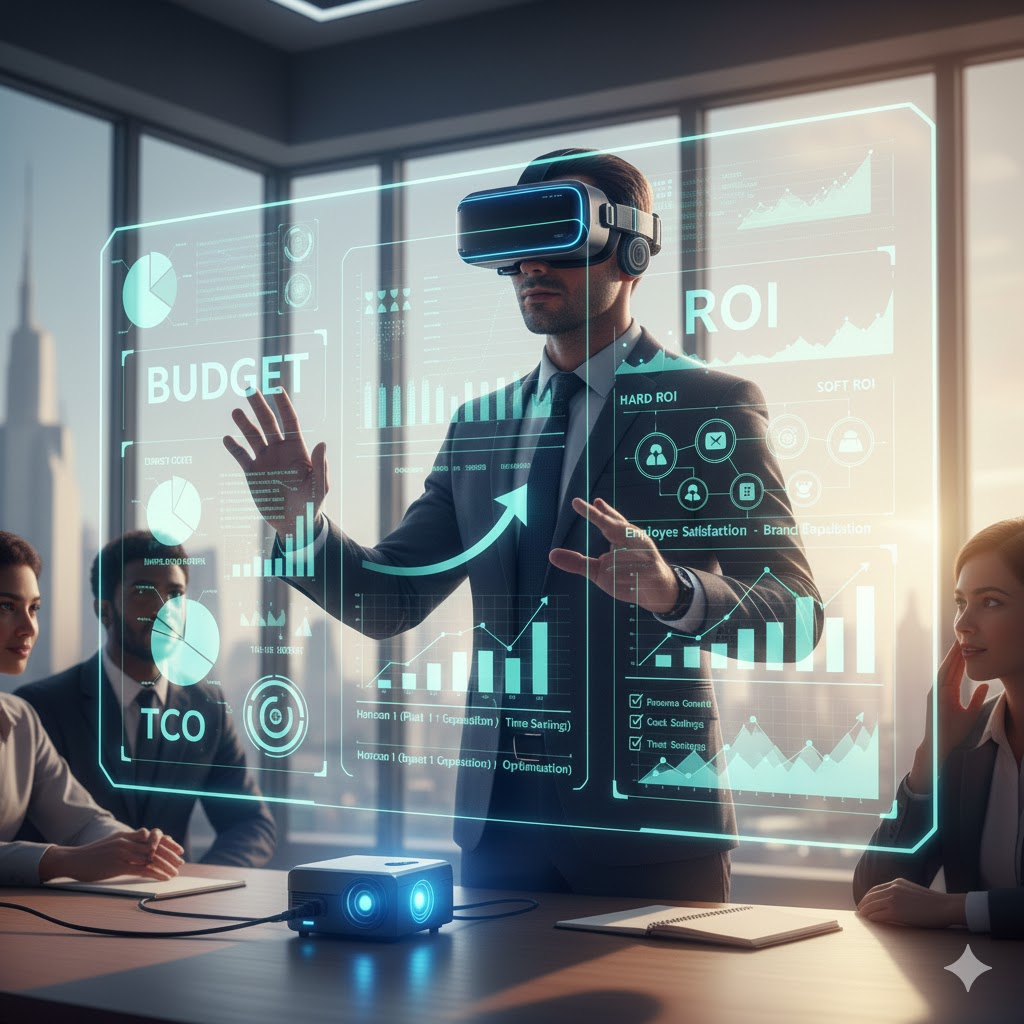
For many businesses, a VR project represents a significant investment, and securing the necessary budget is often the first major hurdle. However, the conversation shouldn’t end at simply getting a quote. The most crucial part of the financial discussion is aligning on value and establishing a clear framework for measuring return on investment (ROI). A visionary Virtual Reality Development Company will work with you not just as a vendor, but as a strategic partner, helping you build a business case that justifies the expenditure and demonstrates long-term value.
To bring clarity to this process, it’s helpful to break down the financial discussion into two distinct categories: the initial investment and the expected returns. The investment is more than just a single number; it’s a collection of costs that contribute to the final product. The returns, on the other hand, are the tangible benefits your business will gain, which must be measured to prove the project’s worth. The following table outlines the key components to consider on both sides of the equation.
| Category | Key Components to Consider | Why It Matters |
|---|---|---|
| The Investment | Fixed Development Fee | Covers the defined scope of work: discovery, design, development, QA, and project management. Provides budget certainty. |
| Hardware & Software | Costs for VR headsets, development computers, and necessary third-party software licenses (e.g., for specific 3D models or SDKs). | |
| Post-Launch Retainer | An ongoing fee for technical support, bug fixes, compatibility updates, and future feature development. Ensures long-term viability. | |
| The Return (ROI) | Direct Financial Gain | Increased sales conversion rates, new revenue streams from the VR experience, or reduced product returns. |
| Operational Efficiency | Reduced training time and costs, lower error rates in complex tasks, improved safety records, and faster design prototyping. | |
| Brand & Competitive Value | Enhanced brand perception as an innovator, improved customer loyalty, and a significant competitive advantage in the market. |
Ultimately, viewing the project as a strategic investment rather than a simple expense is key. While the upfront cost may be substantial, the long-term benefits—such as a safer workforce, a more effective sales process, enhanced brand loyalty, or a significant competitive advantage—can far outweigh the initial outlay.
By having an open and detailed conversation about budget and ROI, you ensure that both you and your development partner are working towards the same goal: creating a VR solution that not only looks impressive but also delivers measurable, bottom-line results for your business.
Conclusion
Selecting the right Virtual Reality Development Company is a multifaceted decision that extends far beyond technical capability. It is about finding a true visionary partner—one that not only possesses the skills to build an immersive experience but also shares your commitment to achieving tangible business results. By following the roadmap laid out in this guide, you are equipped to navigate the selection process with confidence. From the foundational step of defining a clear vision and understanding your audience, to rigorously vetting portfolios, ensuring a collaborative development process, planning for long-term support, and aligning on a budget that delivers a measurable ROI, each stage is critical to your success.
Remember, a successful VR project is a partnership built on communication, transparency, and shared goals. The ideal company will challenge your assumptions, offer innovative solutions, and act as a dedicated guide through the exciting and complex world of virtual reality. As you move forward, use these insights to ask the right questions, demand clarity, and ultimately, choose a partner who will not just build you an application, but will help you architect a new reality for your business and your customers. The future is immersive, and with the right team by your side, your business can be at the forefront of this transformative wave.
Ready to turn your ambitious vision into a groundbreaking virtual reality? The journey begins with a conversation. Cebirra is a Virtual Reality Development Company dedicated to crafting bespoke, high-impact experiences that drive real business value. Contact our expert team today to discuss your project and discover how we can help you lead the way in innovation.