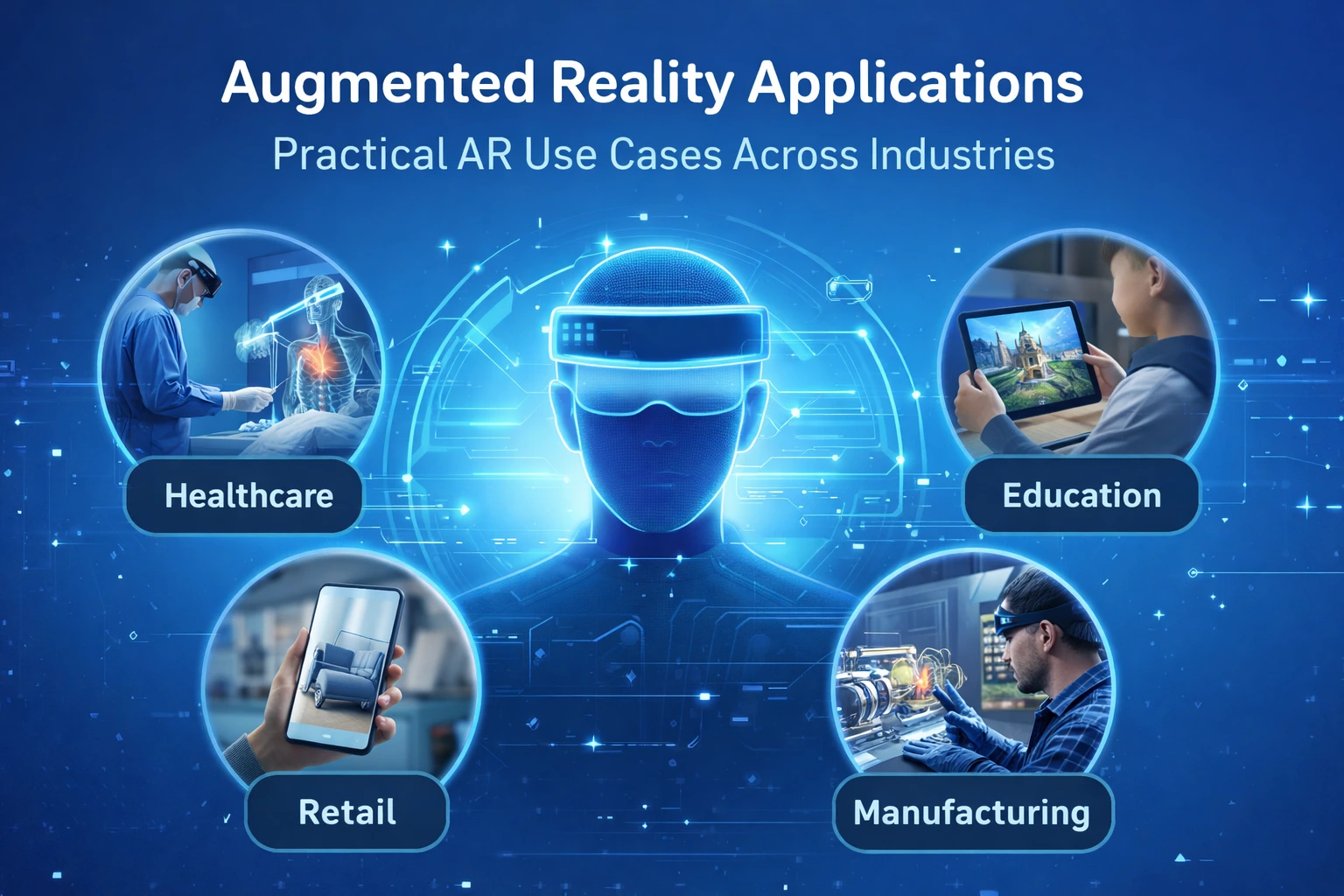
Augmented Reality (AR) is no longer a futuristic concept reserved for science fiction or experimental labs. Today, augmented reality applications are actively transforming how people interact with information, environments, and digital content across industries. From consumer-facing mobile apps to mission-critical enterprise systems, AR has become a practical technology with measurable impact.
This article provides a comprehensive overview of augmented reality applications and real-world AR use cases, explaining what AR is used for, how it delivers value, and why organizations across sectors are adopting AR technology at scale.
What Are Augmented Reality Applications?
Augmented reality applications are digital solutions that overlay computer-generated content—such as visuals, data, or instructions—onto the real world in real time. Unlike virtual reality, which replaces the physical environment entirely, AR enhances the user’s surroundings while maintaining situational awareness.
Modern AR technology uses include smartphones, tablets, smart glasses, and head-mounted displays. These platforms allow users to visualize information contextually, making AR particularly effective for training, visualization, communication, and operational guidance.
Everyday Consumer Augmented Reality Applications
One of the most familiar areas of adoption is consumer technology. Mobile augmented reality applications have brought AR into everyday life, primarily through smartphones.
Popular augmented reality examples include AR games such as Pokémon Go, which demonstrated how virtual objects can seamlessly interact with physical spaces. Social media platforms have also embraced AR, using filters and effects that allow users to modify appearances or environments in real time. These AR applications are not only entertaining but also illustrate how AR can enhance digital communication and creative expression.
In this context, augmented reality is commonly used for:
- Entertainment and gaming
- Social media interaction
- Creative content creation
Enterprise and Industrial AR Applications
Beyond consumer use, enterprise AR applications are driving digital transformation across industries. Organizations are adopting industrial AR applications to improve productivity, reduce errors, and enhance workforce performance.
These business uses of augmented reality include real-time instructions, visual guidance, and remote collaboration. By overlaying critical data directly onto physical tasks, AR helps employees perform complex operations more efficiently and safely. As a result, AR is increasingly viewed as a strategic tool rather than an experimental technology.
Augmented Reality Applications in Healthcare
Healthcare is one of the most impactful areas for AR adoption. Augmented reality applications in healthcare support both clinical practice and medical education.
Surgeons use AR technology to visualize patient data directly within their field of view, improving precision during procedures. Meanwhile, medical students and professionals benefit from immersive AR training tools that present interactive 3D anatomy models and procedural simulations.
Key AR use cases in healthcare include:
- Surgical visualization
- Medical training and education
- Patient engagement and explanation
These applications demonstrate how AR can improve outcomes while reducing risk.
Augmented Reality Applications in Education and Training
Education has embraced AR as a powerful learning tool. Augmented reality applications in education enable students to interact with complex concepts through immersive visualization.
Learners can explore historical artifacts, examine scientific models, or conduct virtual experiments in ways that traditional media cannot support. In professional environments, AR solutions for training provide hands-on experience without exposing learners to real-world hazards.
Common AR use cases in education include:
- Interactive learning content
- Skills training and simulations
- Remote and hybrid learning support
Retail and E-Commerce AR Applications
The retail sector has seen rapid growth in augmented reality applications in retail, particularly in e-commerce. AR allows customers to preview products in real-world contexts before making a purchase.
Examples include virtual try-on experiences for fashion and cosmetics, as well as product visualization for furniture and home décor. These AR use cases in retail improve customer confidence, reduce return rates, and enhance the overall shopping experience.
As a result, augmented reality is becoming a key differentiator in digital commerce strategies.
Manufacturing, Logistics, and Field Services
In industrial environments, augmented reality applications in manufacturing are improving operational efficiency and accuracy. Workers use AR headsets or tablets to access step-by-step instructions overlaid onto machinery, reducing downtime and human error.
AR is also widely used for:
- Equipment maintenance and repair
- Remote expert assistance
- Warehouse and logistics optimization
These AR use cases in manufacturing and logistics demonstrate how AR supports large-scale operations and distributed teams.
AR Technology Uses Across Other Industries
The versatility of AR extends beyond core sectors. Augmented reality applications are increasingly used in:
- Architecture and construction, for project visualization and on-site guidance
- Automotive and aerospace, for design, assembly, and training
- Tourism and travel, for interactive guides and navigation
- Marketing and advertising, for immersive brand experiences
These diverse AR technology uses highlight how augmented reality adapts to different operational and creative needs.
The Future of Augmented Reality Applications
As hardware and software continue to evolve, the future of augmented reality will focus on seamless integration and hands-free interaction. Wearable devices and advanced AR headsets will enable persistent, context-aware digital overlays.
Future augmented reality applications are expected to support deeper collaboration, more intuitive communication, and real-time decision-making across industries. This shift will further position AR as a foundational technology for digital transformation.
Conclusion
Augmented reality applications have moved beyond novelty to become practical, high-impact solutions across sectors. From consumer entertainment to healthcare, education, retail, manufacturing, and enterprise operations, AR delivers real value by enhancing how people interact with information and environments.
By understanding these practical AR use cases, organizations can identify where augmented reality fits into their digital strategy. As adoption continues to grow, augmented reality will play an increasingly important role in shaping how industries operate, learn, and innovate in the years ahead.
Augmented Reality (AR) is no longer a futuristic concept reserved for science fiction or experimental labs. Today, augmented reality applications are actively transforming how people interact with information, environments, and digital content across industries. From consumer-facing mobile apps to mission-critical enterprise systems, AR has become a practical technology with measurable impact.
This article provides a comprehensive overview of augmented reality applications and real-world AR use cases, explaining what AR is used for, how it delivers value, and why organizations across sectors are adopting AR technology at scale.