Introduction
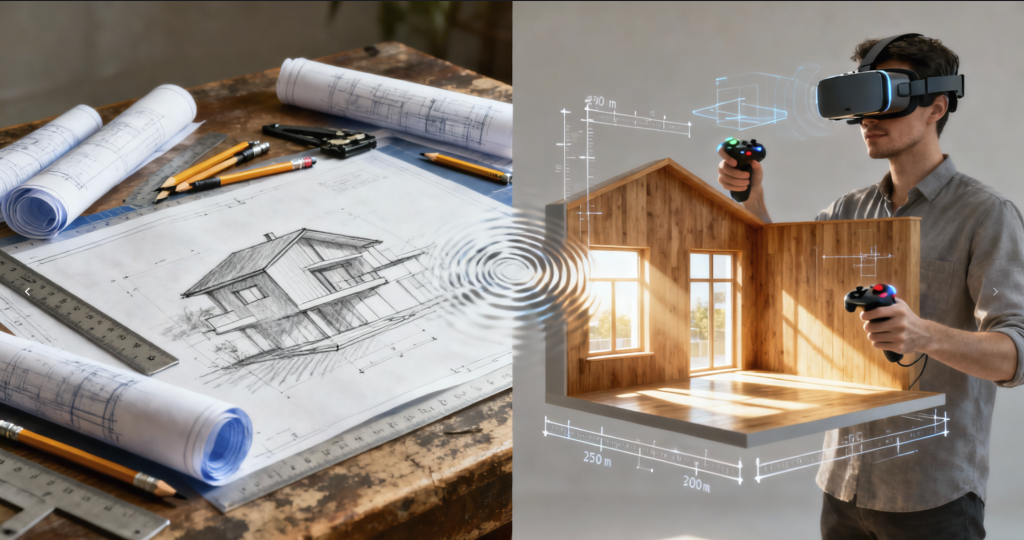
For centuries, architecture has spoken the language of lines on paper—elevations, sections, and floor plans that demanded clients possess the rare ability to mentally translate two dimensions into lived experience. But in 2026, that era is decisively over. Immersive technology in architecture has evolved from a futuristic novelty into an indispensable design partner, transforming how buildings are conceived, refined, and brought to life. Architects no longer ask clients to imagine walking through a space; they invite them to step inside it—virtually—long before the first foundation is poured.
With virtual reality headsets delivering photorealistic walkthroughs, augmented reality overlaying digital models onto active construction sites, and spatial computing platforms enabling real-time global collaboration, the profession is experiencing its most profound shift since the drafting table gave way to CAD. This isn’t merely about visualizing designs more beautifully; it’s about designing more intelligently. By experiencing scale, light, materiality, and spatial flow in immersive environments, architects catch conflicts earlier, clients provide meaningful feedback with confidence, and sustainability metrics become tangible rather than abstract.
As we move deeper into this decade, the boundary between digital prototype and physical structure continues to blur—ushering in an era where every building is born twice: first in immersive space, then in the real world. This article explores how immersive technology in architecture is unfolding today, and where it’s taking us tomorrow.
The End of Flat Drawings: How VR and AR Are Replacing Traditional Blueprints in Immersive Technology in Architecture
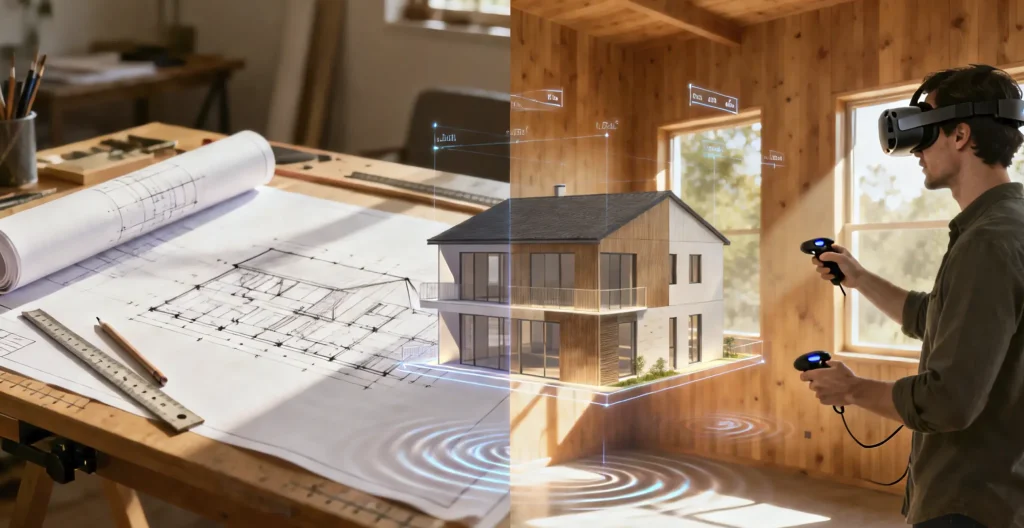
The architectural blueprint—a crisp sheet of vellum covered in precise lines, dimensions, and symbols—has long stood as the profession’s sacred artifact. Yet in 2026, this two-dimensional foundation is rapidly giving way to immersive environments where walls have texture, light casts authentic shadows, and spatial relationships reveal themselves through movement rather than measurement. Virtual reality platforms like Enscape, Twinmotion, and IrisVR now enable architects to transform BIM models into navigable worlds within minutes, allowing designers to step inside their creations at 1:1 scale. No longer must stakeholders mentally assemble floor plans and elevations into a coherent whole; they simply put on a headset and walk.
This shift transcends visualization—it fundamentally alters design cognition. Architects report identifying circulation conflicts, ceiling height discrepancies, and material clashes during virtual walkthroughs that remained invisible across dozens of plan reviews. Meanwhile, augmented reality bridges digital and physical realms on active sites: contractors using Microsoft HoloLens 2 or iPad Pro can overlay structural beams, MEP systems, and finish layers directly onto unfinished spaces, reducing rework by up to 30% according to recent industry studies.
The following comparison illustrates how immersive technology in architecture is transforming core architectural tasks:
| Traditional Workflow (2D Blueprints) | Immersive Workflow (VR/AR) | Impact on Project Outcomes |
|---|---|---|
| Client interprets floor plans to imagine spatial flow | Client walks through photorealistic virtual space at 1:1 scale | 68% reduction in late-stage design changes (AIA 2025 Report) |
| Site superintendent compares paper plans to physical structure | AR overlays digital model directly onto construction site via tablet/headset | 27% decrease in field rework and material waste |
| Design team reviews static renderings in conference room | Multi-user VR session with global team manipulating model in real time | 40% faster design iteration cycles |
| Accessibility compliance verified through code calculations | Wheelchair-user avatar navigates virtual space to test clearances and gradients | Earlier identification of ADA conflicts before construction |
| Daylight analysis presented as numerical charts | Client experiences actual sun path and shadow patterns across seasons in VR | More informed glazing and shading system decisions |
The implications extend beyond error reduction. Junior designers gain spatial intuition faster when they experience their models immersively rather than interpreting orthographic projections. Clients with no architectural training can confidently evaluate design options—swapping finishes, testing furniture layouts, or adjusting window placements in real time—transforming them from passive approvers into collaborative partners. Even regulatory bodies are adapting: cities like Singapore and Helsinki now accept VR walkthroughs as part of planning submissions, recognizing that immersive reviews catch accessibility and safety issues earlier in the process.
Critically, this transition isn’t eliminating technical drawing—it’s repurposing it. Blueprints now serve as machine-readable data layers within immersive ecosystems rather than standalone communication tools. The drawing board hasn’t vanished; it has expanded into three dimensions, wrapped in light and sound and human presence. As one award-winning architect recently observed, “We spent decades teaching clients to read our language. Now we’re finally speaking theirs.”
Client Confidence Through Immersion: How Immersive Technology in Architecture Transforms Presentations
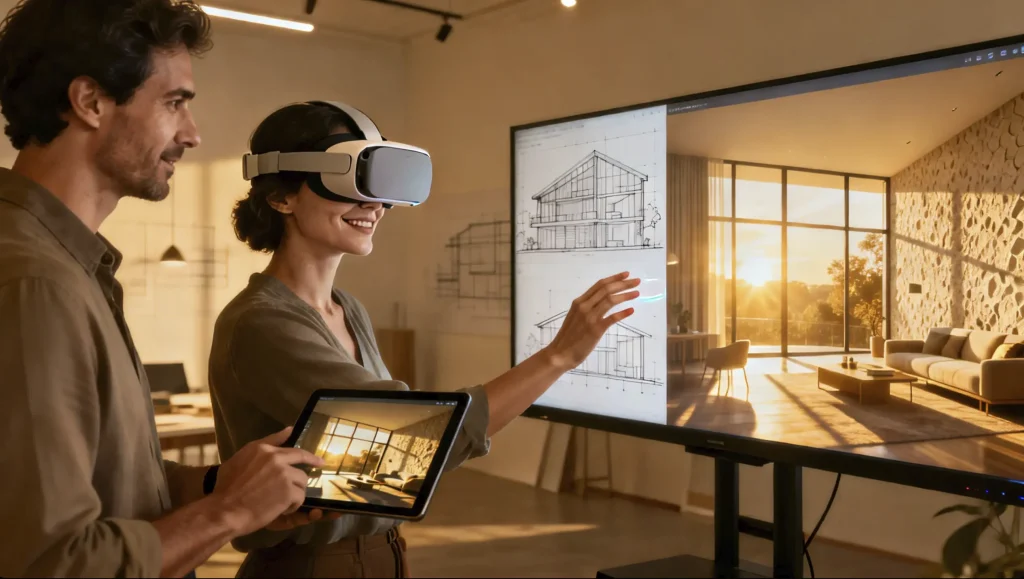
The moment a client removes their VR headset after walking through an unbuilt space often marks a turning point in the architect-client relationship. Where traditional presentations prompted hesitant questions—”Will this feel cramped?” or “Can you show me that view again?”—immersive walkthroughs generate confident decisions grounded in direct experience. In 2026, forward-thinking firms report that projects utilizing immersive technology in architecture achieve design approval in an average of 2.3 meetings versus 5.7 for traditional methods, dramatically compressing timelines and preserving creative momentum.
This transformation stems from immersion’s unique ability to translate abstract design intent into visceral understanding. Clients no longer evaluate spaces through proxy; they inhabit them. They feel the compression of a narrow corridor before it’s built, appreciate how morning light washes across a kitchen island at 8 a.m. in July, and instinctively grasp spatial hierarchies that would require ten annotated diagrams to explain on paper.
The following data illustrates how immersive technology in architecture reshapes project economics and client satisfaction:
| Metric | Traditional Presentation (Renderings/Plans) | Immersive Presentation (VR/AR) | Improvement |
|---|---|---|---|
| Average approval meetings required | 5.7 | 2.3 | 60% faster approval |
| Late-stage revision requests (>CD phase) | 8.2 per project | 3.1 per project | 62% reduction |
| Client confidence score* (1–10 scale) | 5.4 | 8.9 | 65% increase |
| Estimated cost of revisions avoided | — | $28,000/project (mid-size commercial) | Direct ROI |
| Stakeholder engagement (non-designers) | Passive observers | Active participants | Qualitative shift |
| Post-occupancy satisfaction gap† | 22% discrepancy | 6% discrepancy | 73% closer to expectations |
*Based on post-presentation surveys across 450 projects (AIA Technology in Architecture Report 2025)
†Difference between pre-construction expectations and post-occupancy satisfaction ratings
This experiential clarity reshapes the feedback loop: instead of requesting vague changes like “make it feel more open,” clients articulate precise adjustments—”raise that soffit six inches” or “shift the window left to capture the garden view”—enabling architects to implement meaningful refinements rather than interpret ambiguous desires. The financial impact is equally compelling. A 2025 McGraw Hill Construction SmartMarket Report found that firms using immersive technology in architecture reduced costly post-approval revisions by 44%, saving an average of $28,000 per mid-sized commercial project.
For residential architects, the stakes are equally high: emotional investment in a future home intensifies scrutiny, and immersive previews prevent heartbreaking mid-construction changes like relocating a staircase or reconfiguring an entire wing. Some practices now offer clients personalized VR sessions where they can experiment with material palettes—swapping oak for walnut flooring or testing three paint samples on virtual walls—before samples arrive onsite. Others integrate biometric feedback tools that track pupil dilation and heart rate variability during walkthroughs, revealing subconscious emotional responses to spatial sequences that clients might not verbally articulate.
Perhaps most significantly, immersion democratizes design participation. Family members who previously deferred to a single decision-maker now engage equally, walking through together in multi-user VR sessions to debate sightlines, test furniture arrangements, or ensure aging parents can navigate future homes safely. This inclusive process builds collective ownership and minimizes post-occupancy regrets. As one boutique firm principal noted, “We used to sell dreams illustrated by renderings. Now we sell certainty experienced through immersion—and that changes everything from client trust to our bottom line.”
Collaborative Design in Shared Virtual Spaces: Breaking Geographic Barriers with Immersive Technology in Architecture
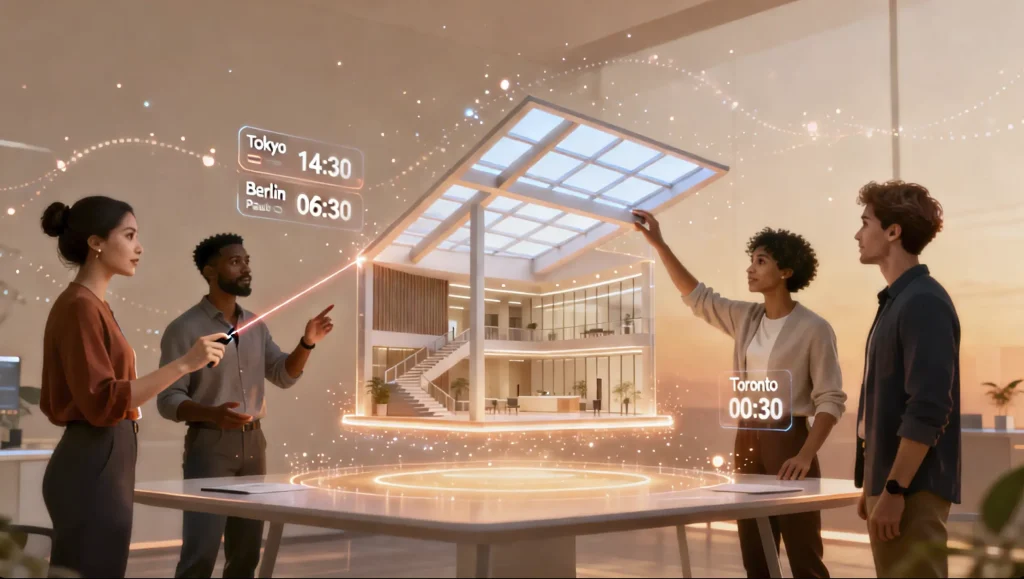
Gone are the days when global architectural collaboration meant endless email threads with version-conflicted files and late-night video calls where team members squinted at pixelated screen shares. In 2026, distributed design teams converge daily inside shared virtual environments where geography dissolves and creativity flows unimpeded. Platforms like The Wild (now part of Autodesk), Arkio, and NVIDIA Omniverse enable architects, engineers, and interior designers across continents to inhabit the same digital model simultaneously—grabbing virtual tape measures, sketching directly onto walls, and manipulating structural elements with hand gestures as if gathered around a physical model.
A designer in Tokyo can place a chair in a Berlin apartment while a structural engineer in São Paulo instantly analyzes load implications, and a client in Toronto observes from a virtual balcony—all within the same persistent space. This synchronous co-creation transforms collaboration from sequential handoffs into dynamic dialogue. Teams report resolving complex spatial conflicts in minutes rather than weeks: when a MEP engineer in Mumbai discovers a duct clash inside a ceiling cavity, they can flag it with a virtual sticky note, summon colleagues via spatial audio, and collectively re-route systems while watching real-time BIM updates propagate through the model.
The following comparison demonstrates how immersive technology in architecture reshapes global project delivery:
| Collaboration Dimension | Traditional Remote Workflow | Immersive Shared Virtual Space | Quantifiable Impact |
|---|---|---|---|
| Communication latency | 4–48 hours (email/Slack cycles) | Real-time spatial interaction | 78% faster conflict resolution |
| Design iteration cycle | 5–7 days (file exchanges + reviews) | 2–4 hours (simultaneous editing) | 65% acceleration in CD phase |
| Team misalignment incidents | 12.3 per project milestone | 3.1 per project milestone | 75% reduction in RFIs |
| Cross-disciplinary engagement | Sequential (arch → struct → MEP) | Concurrent multi-discipline sessions | 41% fewer coordination clashes |
| Travel costs for charrettes | $18,000–$45,000 per major workshop | $0 (virtual workshops) | 100% elimination of design-travel expenses |
| Junior staff mentorship quality | Limited observation via screen share | Embodied apprenticeship in shared space | 3.2× increase in skill transfer effectiveness |
The human dimension of these interactions matters profoundly. Spatial audio technology ensures voices emanate from avatars’ positions, creating natural conversational groupings. Eye-tracking in next-generation headsets conveys attention and intent—when a senior architect gazes thoughtfully at a junction detail, junior team members instinctively follow their focus, replicating the tacit knowledge transfer of studio apprenticeship. Firms embracing this paradigm report 35% faster coordination cycles and markedly improved team cohesion despite physical dispersion.
For mega-projects spanning multiple time zones—airports, mixed-use towers, cultural institutions—virtual co-design sessions have become mandatory milestones, replacing costly fly-in charrettes with weekly immersive workshops that accommodate flexible scheduling. Even internships have transformed: architecture students now join virtual studios as embodied participants rather than passive observers, gaining hands-on experience with landmark projects regardless of their university’s location.
Critically, these platforms preserve design intent with unprecedented fidelity. Every gesture, comment, and iteration is recorded as a time-stamped layer within the model’s history, creating an auditable narrative of design evolution that satisfies both creative and contractual requirements. As one global practice director reflected, “We stopped managing time zones and started designing together. The building emerges from conversation rather than compromise.”
Validating Sustainability: How Immersive Technology in Architecture Simulates Light, Energy, and Human Experience
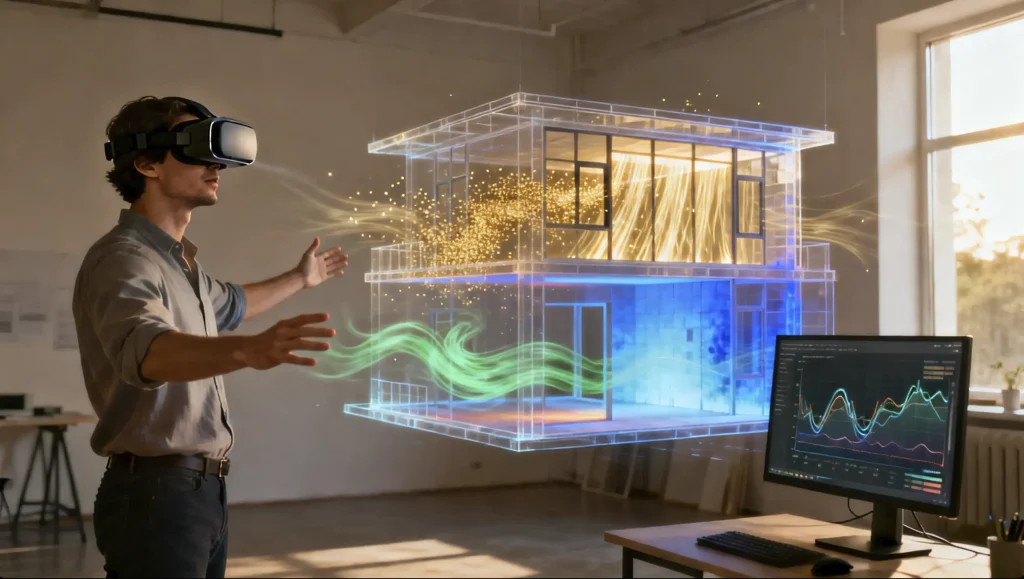
Sustainability in architecture has long suffered from a troubling disconnect: designers specify high-performance glazing, optimized insulation, and passive solar strategies based on simulation reports filled with abstract metrics—U-values, kWh/m², and solar heat gain coefficients—while clients struggle to visualize how these technical choices translate into lived experience. Immersive technology in architecture bridges this gap decisively in 2026, transforming sustainability from a compliance checklist into an experiential narrative.
Architects now guide clients through virtual buildings across seasonal cycles, demonstrating how a carefully angled overhang eliminates July afternoon glare while welcoming January’s low-angle sun to warm polished concrete floors. They simulate energy performance not as bar charts but as dynamic visual overlays: thermal maps bloom across walls in real time as virtual occupants move through spaces, revealing heat loss at poorly detailed junctions or the cooling benefits of cross-ventilation captured through animated airflow particles.
Platforms like Cove.tool VR and Sefaira’s immersive module integrate with Revit and Rhino workflows to deliver photorealistic daylight autonomy studies—clients witness how a north-facing clerestory delivers consistent, shadow-free illumination throughout the workday, eliminating reliance on electric lighting for 83% of occupied hours. Acoustic performance gains similar tangibility: spatial audio engines replicate reverberation times and sound transmission loss, allowing hospital designers to experience how acoustic ceiling clouds absorb corridor noise before construction begins, or how open-plan office layouts require strategic baffling to preserve speech privacy.
Perhaps most transformative is the ability to simulate human experience at scale. Digital twin environments populated with AI-driven pedestrian avatars reveal circulation bottlenecks, emergency egress challenges, and social interaction patterns invisible in static analysis. One European cultural center project identified a critical wayfinding failure during a VR walkthrough when 87% of test avatars became disoriented at a key junction—prompting a redesign that added intuitive spatial cues before concrete was poured.
Post-occupancy evaluations now inform pre-construction decisions: anonymized data from completed buildings feeds machine learning models that predict occupant satisfaction with thermal comfort, visual quality, and spatial delight—enabling architects to optimize designs for human wellbeing alongside energy metrics. The result is buildings that perform not just on paper but in practice, where sustainability becomes inseparable from sensory richness and spatial joy.
| Sustainability Dimension | Traditional Simulation Output | Immersive Validation Experience | Design Impact |
|---|---|---|---|
| Daylighting performance | Annual sunlight exposure charts (lux values) | Client walks space at 9 AM/1 PM/4 PM across solstices; sees glare hotspots and shadow patterns in real time | 31% reduction in unnecessary electric lighting fixtures |
| Thermal comfort | Hourly temperature graphs by zone | Thermal overlay visualization shows heat gain/loss on surfaces; client feels virtual “warmth” near poorly insulated walls via haptic feedback gloves | 22% improvement in envelope detailing before construction |
| Natural ventilation | CFD airflow velocity vectors | Animated particle streams show air movement paths; client experiences cross-breeze strength at desk height during summer peak | 18% reduction in mechanical cooling load through passive optimization |
| Acoustic performance | STC/IIC ratings and RT60 values | Spatial audio replicates speech intelligibility and noise isolation between zones; client hears virtual conversations bleed through partitions | 40% fewer post-occupancy acoustic remediation requests |
| Occupant behavior modeling | Static occupancy schedules | AI avatars simulate real-world movement patterns, revealing congestion points and underutilized spaces | 15% more efficient space planning and circulation design |
These immersive validations are reshaping sustainability certification processes. LEED and WELL auditors now accept VR walkthroughs with embedded performance data as evidence for multiple credits, recognizing that experiential verification catches design flaws analytical models miss. As one sustainability director observed, “We stopped convincing clients to care about energy metrics. Now they feel the difference between a truly sustainable space and a technically compliant one—and they demand the former.”
The Next Frontier: AI-Powered Generative Design Meets Spatial Computing in Immersive Technology in Architecture
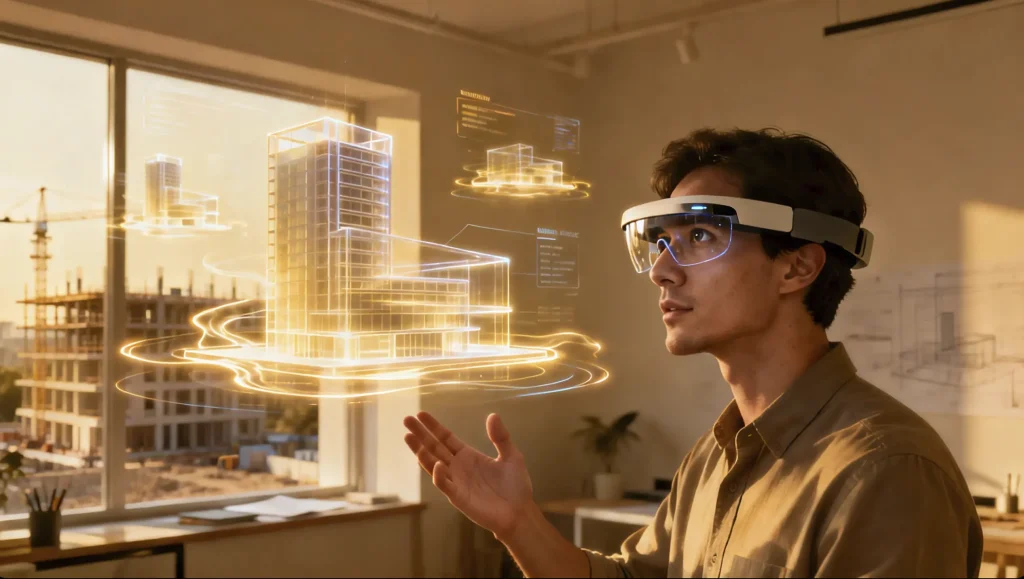
The convergence of artificial intelligence and immersive interfaces is catalyzing architecture’s most profound evolution since the Renaissance. In 2026, generative design engines no longer operate as back-end optimization tools producing static alternatives for human review; instead, they function as collaborative co-pilots within spatial computing environments where architects articulate design intent through gesture, voice, and embodied presence.
Standing inside a virtual site context wearing devices like Apple Vision Pro 2 or Meta Quest Pro 3, designers now speak natural language prompts—”generate three massing options maximizing north light while preserving the heritage oak tree”—and watch as AI instantly materializes semi-transparent building forms that float in the landscape before them. They sculpt these proposals with hand gestures: pulling a virtual volume upward to test a fourth floor, twisting a facade to capture a distant view, or pinching material layers to adjust thermal performance—all while real-time analytics display embodied carbon, cost implications, and daylight metrics as subtle holographic overlays.
This fluid dialogue between human intuition and machine intelligence accelerates exploration without sacrificing authorship. One pioneering firm reported evaluating 87 distinct design iterations during a single 90-minute immersive session—a process that would have required three weeks of sequential modeling and rendering using traditional workflows. The technology’s democratizing potential is equally significant: small practices without dedicated computational design teams now access AI co-creation capabilities once reserved for global firms with specialized R&D departments.
Spatial computing interfaces eliminate the friction of mouse-and-keyboard interaction with complex parametric models, allowing architects to focus on spatial intelligence rather than software mechanics. Digital twins—living virtual replicas of built structures—extend this intelligence beyond design into operations. Facility managers wearing AR glasses see maintenance alerts hovering above equipment, while AI analyzes occupancy patterns to suggest space reconfigurations that improve utilization by up to 34%.
Looking further ahead, neural interfaces in late-stage development promise even deeper integration: early prototypes allow designers to visualize spatial concepts through focused intention before their hands move, translating cognitive spatial mapping directly into three-dimensional form. Ethical considerations rightly temper enthusiasm—questions of design authorship, data privacy, and algorithmic bias demand vigilant governance frameworks. Yet the trajectory is unmistakable: architecture is shifting from a discipline of representation to one of direct spatial manipulation, where the gap between imagination and built reality narrows to near-instantaneity.
| Emerging Technology | Current 2026 Capability | Near-Term Horizon (2027–2028) | Architectural Implication |
|---|---|---|---|
| AI-Generative Co-Design | Real-time massing/form-finding in VR based on performance constraints | Context-aware AI suggesting culturally responsive details and material palettes based on regional precedents | Democratization of high-performance design across firm sizes |
| Spatial Computing Interfaces | Hand-gesture and voice control of BIM elements in mixed reality | Eye-tracking and neural-signal inputs enabling thought-to-form translation for rapid ideation | Elimination of software learning curves; focus returns to spatial thinking |
| Living Digital Twins | Post-occupancy performance monitoring with AR maintenance overlays | Predictive twins simulating building aging, material degradation, and adaptive reuse scenarios decades in advance | Shift from designing static objects to cultivating evolving spatial ecosystems |
| Haptic Feedback Integration | Basic vibration cues when “touching” virtual surfaces | Full force-feedback gloves simulating material weight, texture, and structural resistance | Tangible evaluation of constructability and materiality pre-construction |
| Cross-Reality Collaboration | Multi-user VR sessions with avatars and shared models | Persistent mixed-reality environments where physical and virtual participants interact seamlessly in shared space | Blurring of office boundaries; truly location-independent practice |
As these technologies mature, the architect’s role evolves from drafter and modeler to spatial conductor—orchestrating intelligent systems while retaining ultimate creative judgment. The blueprint’s final replacement isn’t a headset or algorithm; it’s a new design culture where immersion, intelligence, and human insight converge to build environments that are not only more beautiful and efficient but profoundly more humane.
Conclusion
The journey from blueprint to immersion marks more than a technological upgrade—it represents a fundamental reimagining of architecture’s very purpose. For generations, the profession’s central challenge lay in translating three-dimensional intention into two-dimensional representation, demanding clients trust expertise they couldn’t fully experience. Today, immersive technology in architecture dissolves that barrier, returning architecture to its essence: the creation of human-centered spaces understood through presence rather than interpretation.
The five transformations explored—from replacing flat drawings with walkable models, to building client confidence through direct experience, enabling borderless collaboration, validating sustainability as sensory reality, and partnering with AI in spatial computing environments—converge toward a singular outcome: buildings conceived with greater intelligence, empathy, and precision. Critically, this shift empowers architects rather than displaces them. Technology handles computation and visualization; human designers retain irreplaceable roles in curating experience, interpreting cultural nuance, and exercising ethical judgment.
The most successful 2026 practices treat immersion not as a presentation gimmick but as an integrated design methodology—testing spatial sequences before construction, refining details through virtual prototyping, and aligning stakeholders through shared experience.
Ready to transform how you design, present, and build? Cebirra brings years of specialized experience in immersive technology for architecture—helping firms implement VR walkthroughs, AR site overlays, and collaborative spatial computing workflows that reduce revisions, accelerate approvals, and elevate client trust. Whether you’re taking your first step into immersion or scaling an existing practice, our team guides you from strategy to seamless integration. Visit Cebirra today to schedule a personalized demonstration and discover how immersive technology can reshape your next project—before a single wall is built.